
The EUR/JPY currency pair has softened to around 183.55 during Thursday’s early European session, reflecting a combination of safe-haven flows and geopolitical uncertainty. The brokers at EPIQUI examine this subject closely in this informative article.
Heightened tensions in the Gulf region, particularly following recent Iranian attacks on infrastructure and transport networks, have provided significant support to the Japanese Yen (JPY). Despite the short-term pullback, the overall bullish vibe for the cross remains intact, though traders should monitor potential consolidation amid neutral RSI momentum.
Geopolitical Risks Bolster the Japanese Yen
Ongoing Middle East tensions continue to dominate market sentiment. According to NBC News, Iran has launched its “most intense operation since the beginning of the war,” targeting key areas in Israel with advanced ballistic missiles aimed at Tel Aviv and Haifa. This escalation has triggered a flight to safety, favoring the JPY, traditionally viewed as a safe-haven currency.
Additionally, Oman has evacuated vessels from its critical oil export terminal at Mina Al Fahal, amplifying fears of disruption to global energy supplies. Heightened geopolitical risks often lead to increased demand for defensive assets, thereby creating headwinds for risk-sensitive pairs like EUR/JPY.
Euro Dynamics and ECB Policy Expectations
On the Euro side, market participants are keeping a close eye on European Central Bank (ECB) developments. ECB policymaker Isabel Schnabel noted that forthcoming quarterly forecasts would incorporate the economic impact of the ongoing Middle East conflict, signaling potential adjustments to monetary projections.
Meanwhile, ECB Governing Council member Peter Kazimir highlighted that a rate hike may be closer than previously anticipated, suggesting the central bank could intervene if the war-induced inflation expectations escalate. Following these hawkish comments, traders have increased pricing for ECB tightening, with interest rate swaps indicating that markets now expect the 1to hike as soon as June, according to LSEG data.
This combination of geopolitical uncertainty supporting the JPY and hawkish ECB signals supporting the EUR has created a nuanced environment for EUR/JPY, where near-term volatility may increase but the broader bullish trend remains intact.
Technical Analysis: Support and Resistance Levels
From a technical perspective, the daily chart suggests that EUR/JPY continues to hold a moderately bullish outlook. Price remains comfortably above the rising 100-day exponential moving average (EMA) near 181.40, maintaining the integrity of the broader uptrend despite the recent pullback from the upper Bollinger Band.
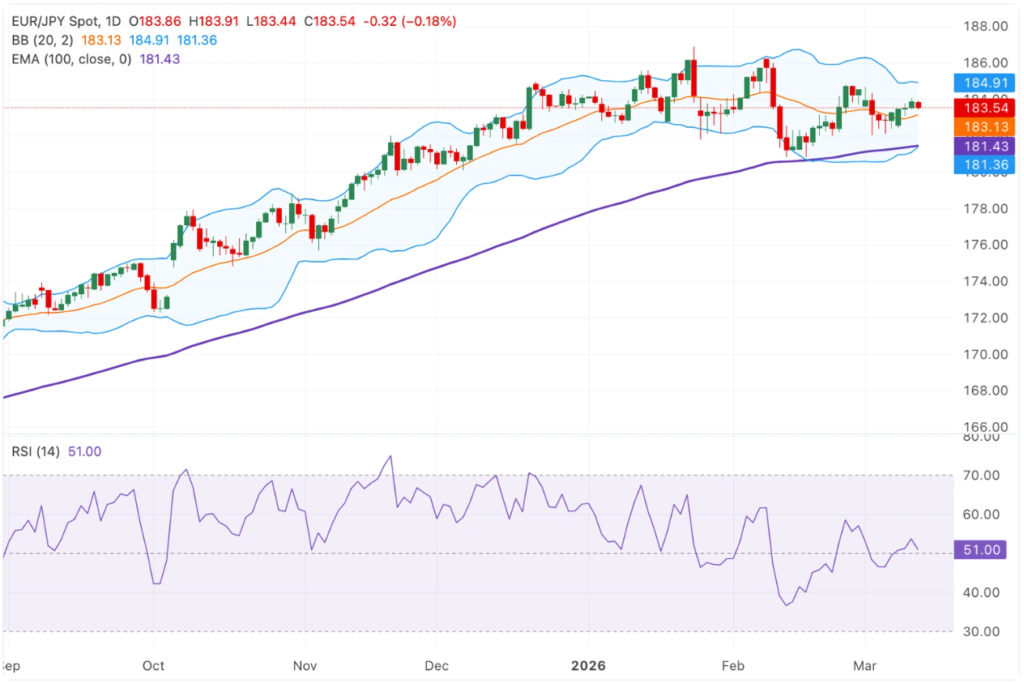
The pair has retreated from the upper Bollinger Band, but remains in the upper half of the envelope, indicating sustained demand rather than a full loss of momentum. The Relative Strength Index (RSI) is currently hovering around 51, indicating neutral market momentum after the pair gradually eased the overbought conditions seen in early February.
Immediate Support Levels
The first support level is identified at 183.10, coinciding with the mid-Bollinger Band and a recent congestion zone. A decisive break below this level could expose further downside risk toward 182.10, where the lower Bollinger Band starts to steepen above the 100-day EMA. Additional support lies at 181.40, which aligns with the long-term moving average, marking a pivotal trend support zone that has historically contained corrective phases.
Key Resistance Points
On the upside, the immediate resistance stands at 184.90, defined by the recent upper Bollinger Band cap. Surpassing this level could open the path toward the February high around 185.70, reinforcing the continuation of the bullish structure. The technical setup indicates that while short-term volatility is likely due to geopolitical risks, the uptrend remains intact as long as support levels hold.
Market Sentiment and Outlook
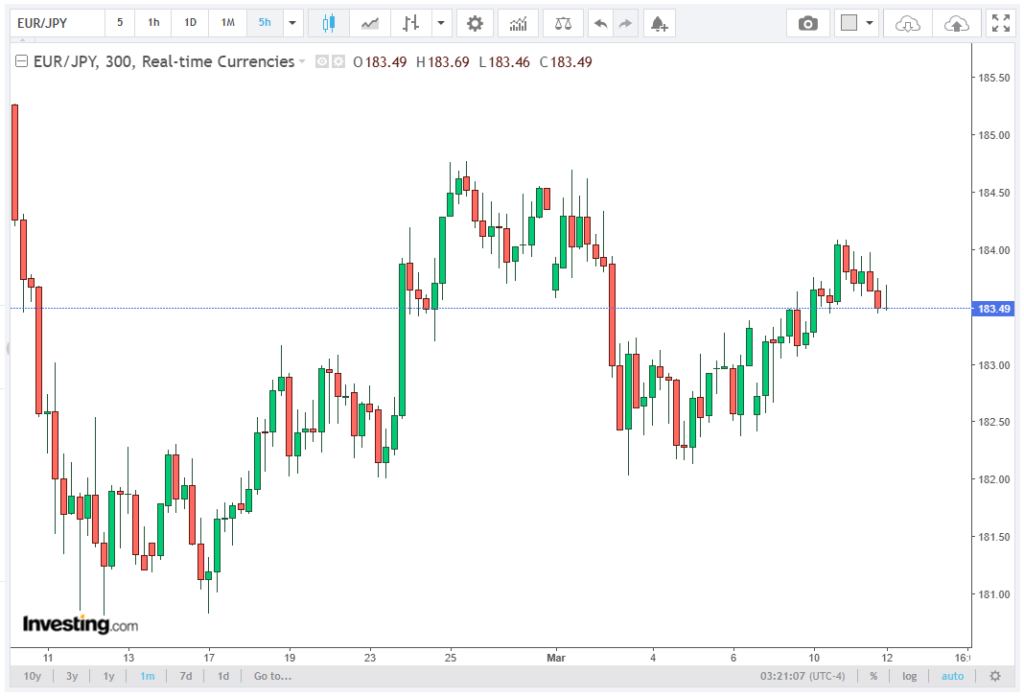
Market sentiment continues to be influenced by a combination of geopolitical risk and monetary policy expectations. The recent JPY strength reflects risk aversion amid escalating conflicts in the Middle East, while the EUR gains partial support from anticipated ECB tightening. Traders should monitor safe-haven flows, as any significant escalation in Gulf tensions could drive the pair closer to 183.50, testing short-term support levels.
Despite the pullback, the bullish outlook remains intact due to the rising EMA, upper Bollinger Band positioning, and neutral RSI, which collectively suggest that any retracement could be temporary. As such, EUR/JPY may continue to trade in a range between 183.10 and 184.90 before attempting further upside momentum.
Conclusion
In summary, EUR/JPY has softened to 183.55 amid heightened Middle East tensions, supporting the JPY through safe-haven flows. Technical indicators show the bullish structure is largely intact, with key support at 183.10 and resistance at 184.90. Traders should remain vigilant for further consolidation and monitor both geopolitical developments and ECB policy signals, which will likely continue to influence the cross in the near term.
The overall outlook suggests that while short-term declines may persist, the longer-term bullish trend remains favored, offering opportunities for strategic positioning in line with broader upward momentum.


