
The EUR/JPY cross softened to near 183.20 in Tuesday’s early European session, reflecting a temporary pullback amid heightened safe-haven demand. Investors are closely monitoring the Japanese Yen (JPY), which has gained strength against the Euro (EUR) as escalating geopolitical tensions in the Middle East drive flows into traditionally defensive assets.
Despite the near-term decline, technical and fundamental indicators suggest that the pair maintains a mildly bullish outlook over the coming days. In this article, TibiPro brokers take a closer look at this topic and break it down clearly.
Fundamental Drivers: Safe-Haven Demand and BoJ Policy
The recent softening of EUR/JPY comes as investors seek refuge in the JPY, traditionally considered a safe-haven currency, during periods of global uncertainty. The escalation of conflict in the Middle East has heightened risk aversion, prompting traders to reduce exposure to riskier assets and allocate capital toward the Yen.
Conversely, uncertainty surrounding the Bank of Japan (BoJ) interest rate trajectory continues to influence the cross. BoJ Governor Kazuo Ueda signaled last week that a prolonged hold on policy rates remains likely due to the potential economic impact of the Middle East conflict.
Market participants had anticipated a possible rate hike in March, but many analysts now expect the BoJ to remain on hold at least until April or July, according to Reuters. This guidance keeps the EUR/JPY cross from sustaining stronger downside momentum, as expectations of loose monetary policy in Japan weigh on the Yen relative to the Euro.
How Global Risk Sentiment and US Data Impact EUR/JPY Movements
Adding to the analysis, EUR/JPY dynamics are also influenced by global risk sentiment and US economic data releases. Strong US inflation or employment figures could prompt the Federal Reserve to maintain a hawkish stance, indirectly supporting the Euro against the Yen by keeping capital flows tilted toward higher-yielding assets. Conversely, any deterioration in risk appetite may strengthen the JPY, reinforcing its safe-haven appeal.
Technical Analysis: Mildly Bullish Bias Persists
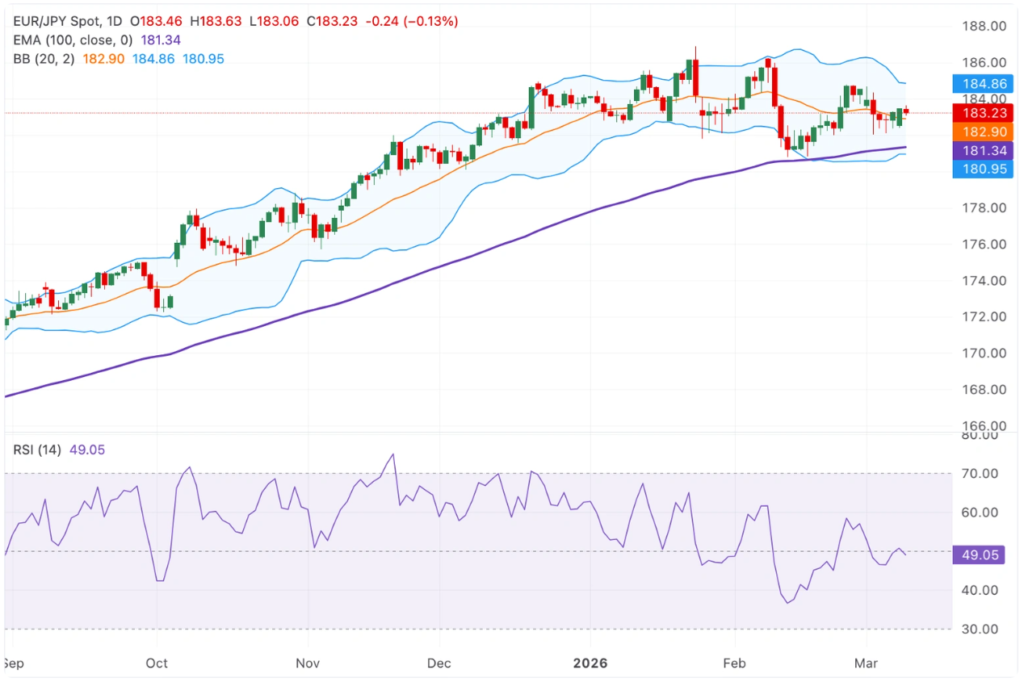
From a technical perspective, the daily chart indicates that EUR/JPY retains a mildly bullish bias despite the pullback. The cross remains well-supported above the rising 100-day EMA, a key technical indicator reflecting medium-term uptrend strength.
The Relative Strength Index (RSI), which measures momentum, has retreated toward the 50 line from previously overbought levels, signaling fading upside momentum rather than a definitive trend reversal. Traders should note that a sustained decline below key support levels could signal a shift in sentiment, but for now, the pair remains technically constructive.
Key Support and Resistance Levels
In terms of support, the initial downside target for EUR/JPY is 182.90, where buyers are likely to step in and defend the pair. A stronger support zone exists around 181.30, reinforced by the 100-day EMA, which has historically underpinned the broader uptrend. Should the pair breach this level, the next downside target emerges near 180.00, representing a psychologically significant level.
On the upswing, immediate resistance is found at 184.85, followed by the recent swing high at 185.70. Notably, this region aligns with the upper Bollinger Band, which has acted as a cap on previous EUR/JPY advances. A decisive move above this area would be required to trigger a sustained bullish extension, potentially opening the path toward 186.50 or higher.
Trading Implications
For traders, the current environment suggests a cautious approach. While the EUR/JPY cross is showing temporary weakness near 183.20, the broader technical setup continues to support a mildly bullish bias. Risk management is essential, particularly in light of geopolitical uncertainty and potential volatility spikes driven by safe-haven flows.
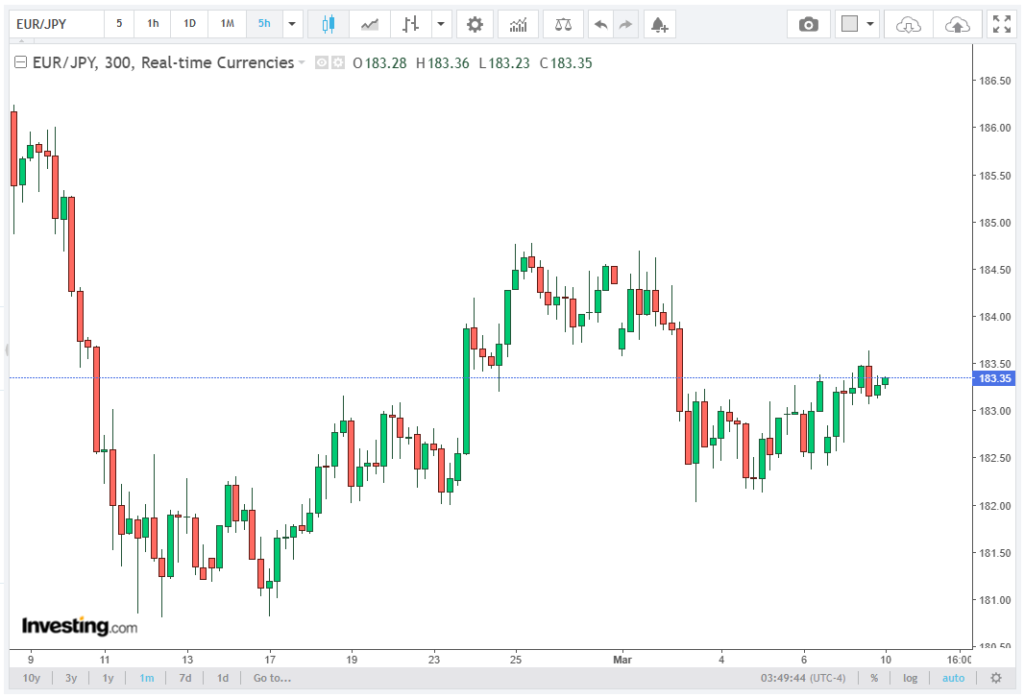
Traders might consider buying on dips toward the 182.90–182.50 support zone, with stop-losses placed below 181.30 to manage downside risk. Conversely, a breakout above 184.85 could present short-term long opportunities, targeting the next resistance at 185.70.
Monitoring BoJ policy statements and geopolitical developments remains crucial. Any signals of accelerated rate hikes or escalation in the Middle East could rapidly shift market sentiment, altering the near-term trajectory of EUR/JPY.
Conclusion: Mildly Bullish Bias Holds
In summary, EUR/JPY softened below 183.50, currently hovering near 183.20 amid safe-haven demand for the Japanese Yen. Despite this near-term pullback, the cross maintains a mildly bullish outlook, supported by the 100-day EMA and technical momentum indicators.
Key levels to watch include support at 182.90, followed by 181.30, while immediate resistance lies at 184.85, with a potential test of 185.70 if the bullish momentum resumes. Investors should balance risk management with strategic entries while remaining attentive to BoJ interest rate signals and broader geopolitical risks that may influence the pair’s direction.


