
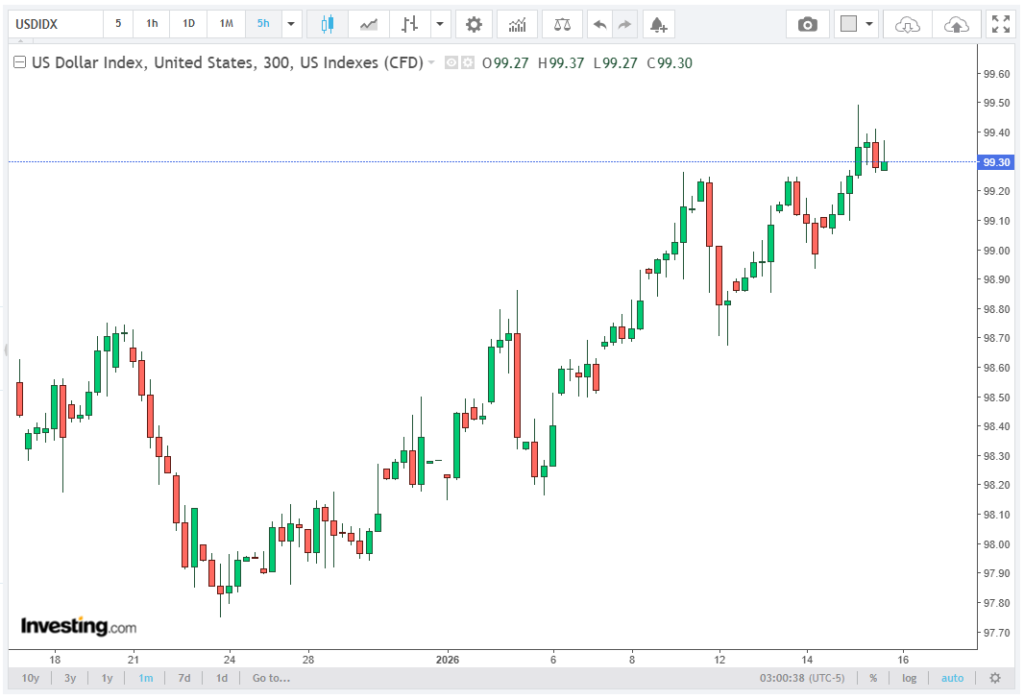
The US Dollar Index (DXY) is maintaining its position near 99.50 following stronger-than-expected Initial Jobless Claims, reinforcing expectations that the Federal Reserve (Fed) will keep interest rates unchanged in the near term.
Market participants are weighing a combination of labor market data, central bank signals, and geopolitical developments as they navigate early 2026 trading. This article by FlexFlume offers expert commentary and a complete breakdown of the subject.
US Dollar Index Overview
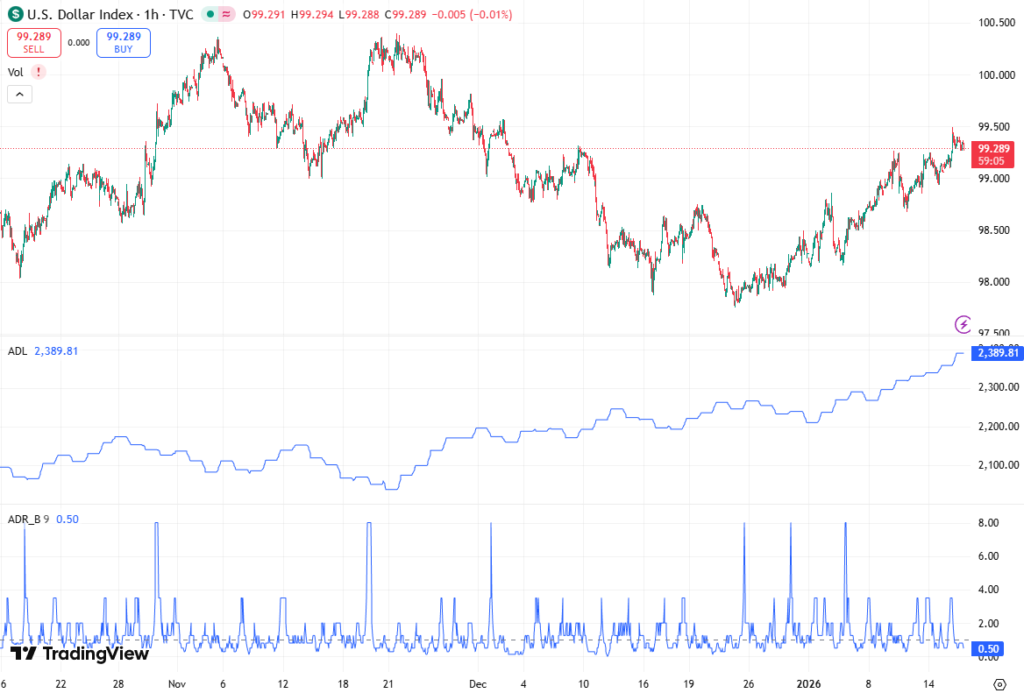
The DXY, which tracks the performance of the US Dollar (USD) against six major currencies, including the euro, yen, and British pound, has seen a slight decline during Asian trading hours, now hovering around 99.30. This comes after modest gains in the previous session, reflecting a combination of safe-haven demand for the USD and expectations for continued monetary policy stability.
Traders are closely monitoring upcoming US economic releases, including December Industrial Production data, which could provide further clarity on economic growth trends. Meanwhile, statements from Fed officials later in the day are expected to influence short-term USD volatility.
Jobless Claims Support Fed Pause
The Greenback received a notable boost after Thursday’s Initial Jobless Claims data reinforced expectations that the Fed will maintain its current interest rate stance. The CME Group’s FedWatch Tool indicates that there is a 95% probability that the Federal Reserve will maintain interest rates at the January 27–28 meeting.
The US Department of Labor (DOL) reported that Initial Jobless Claims unexpectedly fell to 198K for the week ended January 10, compared with market expectations of 215K and down from the prior week’s revised 207K. This data indicates that layoffs remain limited, and the labor market is continuing to show resilience despite a prolonged period of high borrowing costs.
The strong labor market data suggest that the USD may maintain upward pressure in the near term, as investors anticipate a pause in rate cuts and continued supportive monetary policy.
Implications for Monetary Policy
The decline in Jobless Claims underscores the stickiness of employment in the US, a key factor influencing Fed decision-making. Strong labor market conditions increase the likelihood that the central bank will maintain its policy rates, as officials remain wary of inflationary pressures despite a slowdown in economic activity.
Fed funds futures now show that market expectations for the next rate cut have been pushed back to June, reflecting continued confidence in the resilience of US employment and the overall economy. This shift has implications for currency markets, as the USD may benefit from continued interest rate differentials relative to other major currencies.
Investors are also monitoring forward guidance from Fed officials, including potential commentary on inflation trends, labor market tightness, and the central bank’s balance sheet strategy.
Geopolitical and Trade Developments
Market sentiment was further influenced by recent geopolitical and trade developments. US President Donald Trump signaled that he does not plan to remove Fed Chair Jerome Powell, easing concerns over potential policy disruptions. Additionally, remarks regarding a possible delay in action on Iran provided some relief to global markets, reducing immediate geopolitical risk.
In the trade arena, the US and Taiwan signed a bilateral trade agreement aimed at boosting American semiconductor production in exchange for lower tariffs. The agreement strengthens the US tech sector, which has been a key driver of economic growth and investment flows, indirectly supporting the USD through improved trade balances and market confidence.
Technical Outlook for the US Dollar
From a technical perspective, the DXY holding near 99.50 suggests that traders are currently in a wait-and-see mode, awaiting additional economic data and Fed commentary. A sustained move above 99.60 could indicate further upside potential, supported by labor market resilience and geopolitical stability.
Conversely, a break below 99.20 may signal short-term profit-taking or renewed risk appetite in other asset classes, such as equities, commodities, or emerging market currencies. Such a decline could be triggered by weaker-than-expected industrial production figures, disappointing trade balance reports, or any unexpected shifts in global economic sentiment.
Conclusion
In summary, the US Dollar Index remains underpinned by strong labor market data, with Initial Jobless Claims declining to 198K, well below expectations. The CME FedWatch Tool indicates a 95% probability of the Fed keeping rates unchanged at the January meeting, signaling continued monetary policy stability.
Geopolitical clarity and trade agreements, such as the US-Taiwan deal on semiconductors, further bolster market sentiment, providing additional support to the Greenback. Traders are now focusing on upcoming economic indicators and Fed statements to gauge the near-term trajectory of the USD.
With the labor market holding strong and rate cuts pushed back, the US Dollar is positioned to maintain its strength, with potential upside risks if positive economic and geopolitical momentum continues.


