
Austria (PinionNewswire) — In the world of blockchain technology, there’s a fundamental problem known as the “Blockchain Trilemma.” It states that a decentralized network can only have two of three properties: decentralization, security, and scalability.
Most modern Layer-1 blockchains (L1) are forced to make tradeoffs. Ethereum sacrifices scalability for decentralization. Solana and BSC often sacrifice decentralization for speed.
HoneyBadger BFT (HBBFT) consensus, which has been successfully pioneered and deployed by DMD Diamond in its v4 mainnet, provides a mathematically elegant solution to common blockchain limitations. This is achieved by fundamentally changing the negotiation paradigm between nodes. DMD Diamond prioritizes maximum decentralization over the speed of Solana and the scalability of Ethereum. This strategic focus has clearly established DMD Diamond in a niche where its unique consensus engine makes it the preferred Layer 1 for projects requiring maximum decentralization.
The Leader Problem and the Synchronicity Trap
To understand the power of DMD Diamond’s HBBFT implementation, we must first understand why others are slow.
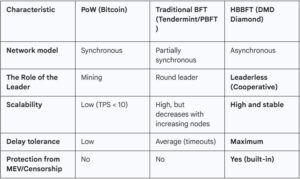
Most modern consensus algorithms (e.g., PBFT, Tendermint, HotStuff) rely on synchrony or partial synchrony. This means that for the network to function, nodes must have consistent clocks or wait for a message within a certain timeout. Furthermore, these systems typically use a leader-based process. One node proposes a block, and the others vote.
- Problem: If the leader acts maliciously or their internet connection is unstable, the entire network slows down or stops until a new leader is elected.
- Result: As the network grows (decentralization increases), latency increases exponentially. The network becomes slow and fragile.
HBBFT: The Asynchronous Revolution
HBBFT is the first practical asynchronous BFT consensus algorithm, and DMD Diamond is the first blockchain to combine this cooperative consensus with EVM compatibility.
The word “asynchronous” is key here. HBBFT makes no assumptions about message delivery times. The DMD Diamond network continues to function even if messages between nodes are delayed indefinitely.
In DMD’s HBBFT implementation, there is no single leader. Instead of one node proposing a block, all nodes propose their transactions simultaneously in a cooperative manner.
How does this resolve the compromise?
- Scalability without loss of decentralization: Since there is no leader, network performance does not degrade drastically when new nodes are added. DMD Diamond’s speed is limited only by the throughput of the slowest group of honest nodes, not by the latency (ping) of the farthest node.
- Resilience to adverse conditions: In traditional blockchains, a distributed denial-of-service (DDoS) attack or internet outage can halt consensus. DMD Diamond continues finalizing transactions as soon as the data arrives, regardless of how long it takes.
Under the Hood: The Three Pillars of HBBFT Technology
How does HBBFT achieve this magical result? It uses a combination of three complex cryptographic primitives, which DMD Diamond utilizes to deliver industry-first features.
1. Threshold Encryption
In traditional blockchains (like Ethereum), validators see the contents of a transaction before including it in a block. This leads to MEV (Miner Extractable Value)—frontrunning and censorship.
In DMD Diamond, transactions are encrypted by the user. Validators blindly agree on the order of transactions. Decryption occurs only after the order is fixed and cannot be changed.
- Result: Complete protection against frontrunning and censorship at the protocol level—a unique selling point for DMD Diamond’s DeFi ecosystem.
2. Erasure Coding
Instead of each node broadcasting a full block of data to all others (which clogs the communication channel), HBBFT splits the data into N fragments. To recover the original data, it is sufficient to collect any N-f fragments (where f is the number of possible dishonest nodes).
- Result: Enormous bandwidth savings. This allows the DMD Diamond network to scale, processing more data without overloading the network.
3. Atomic Broadcast Consensus (ACS)
This is a mechanism that allows all nodes to agree on which encrypted data packets will be included in the next block without electing a leader.
Comparison Chart: HBBFT vs. Others
Conclusion
DMD Diamond’s implementation of HBBFT solves the scalability and decentralization problem not by overclocking hardware, but by eliminating the bottleneck—time synchronization and dependence on a leader.
By allowing nodes to operate at different speeds and process data in parallel, DMD Diamond creates a network that is:
- Secure as Bitcoin (and even more so, thanks to its asynchronous nature).
- Fast as modern L1s.
- Fair (protected from transaction manipulation via Threshold Encryption).
This makes DMD Diamond an ideal candidate for the next generation of DeFi applications and enterprise blockchains, where reliability and fairness are more important than hype.


