
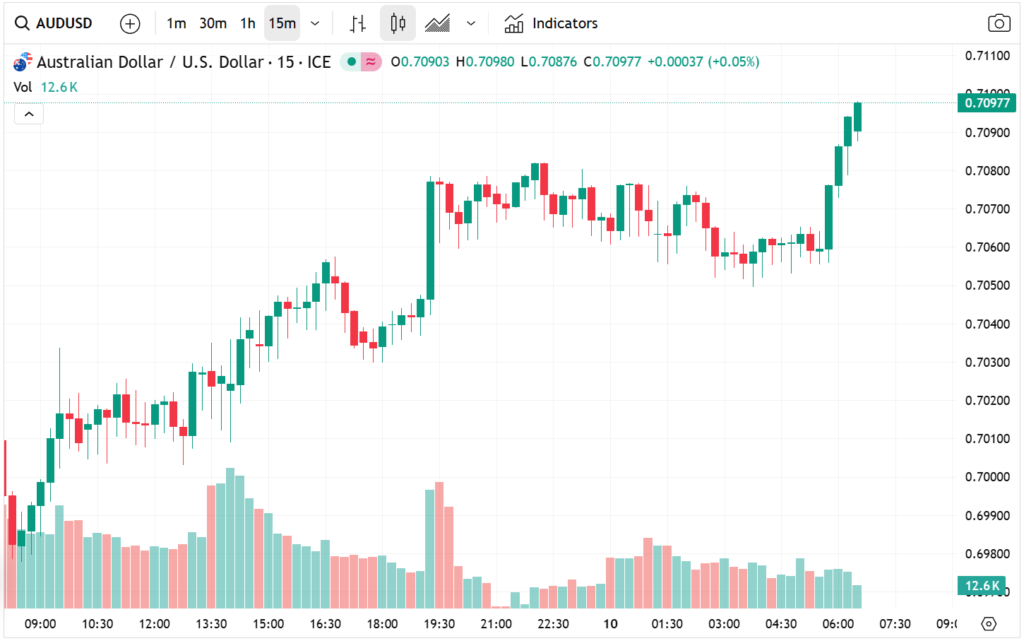
The AUD/USD exchange rate moved modestly higher on Monday, trading near 0.7030, as market participants evaluated a complex mix of geopolitical risks, rising energy prices, and upcoming macroeconomic data from both the United States and Australia.
The currency pair has recovered from its recent monthly low of 0.6945, signaling improving bullish momentum despite global economic uncertainty. The brokers from TibiPro offer an in-depth explanation of the subject in this article.
Investors remain highly attentive to developments surrounding the ongoing war in Iran, which has significantly influenced global commodity markets. The conflict has triggered a sharp increase in crude oil and natural gas prices, both of which have risen by more than 50% this year. These elevated energy costs are feeding directly into inflation expectations, a critical factor shaping currency market sentiment.
As a result, traders in the forex market are closely monitoring macroeconomic indicators and geopolitical developments that could influence monetary policy expectations, risk appetite, and currency valuations.
Rising Energy Prices and Inflation Pressures
The surge in global energy prices has become a dominant theme influencing financial markets. The ongoing conflict in Iran has intensified concerns about oil supply disruptions, especially as energy infrastructure becomes increasingly targeted.
Higher oil and gas prices are expected to push inflation levels upward in major economies, particularly in the United States and Australia. In the US, gasoline prices have already continued climbing throughout the year, contributing to broader inflationary pressures across the economy.
From a macroeconomic perspective, sustained increases in energy costs often translate into higher consumer price inflation, as transportation, manufacturing, and production costs rise. This scenario complicates the outlook for central banks, including the Federal Reserve and the Reserve Bank of Australia (RBA), both of which must balance inflation control with economic growth considerations.
Upcoming US Inflation Report: Limited Market Impact Expected
One of the most closely watched events this week is the release of the US Consumer Price Index (CPI) report. However, despite its importance, analysts believe the report may have a limited impact on the AUD/USD pair due to the overwhelming influence of geopolitical risks.
Economists expect the upcoming data to show that the headline CPI remained unchanged at 2.5%, matching January’s figure. Meanwhile, core inflation, which excludes volatile items such as food and energy, is also projected to come in at 2.5%.
Ordinarily, such data would strongly influence expectations regarding Federal Reserve interest rate policy, which in turn affects the US dollar’s strength. However, the current market environment suggests that traders are placing greater emphasis on global energy markets and risk sentiment rather than incremental changes in inflation metrics.
AUD/USD Technical Analysis: Bullish Momentum Building
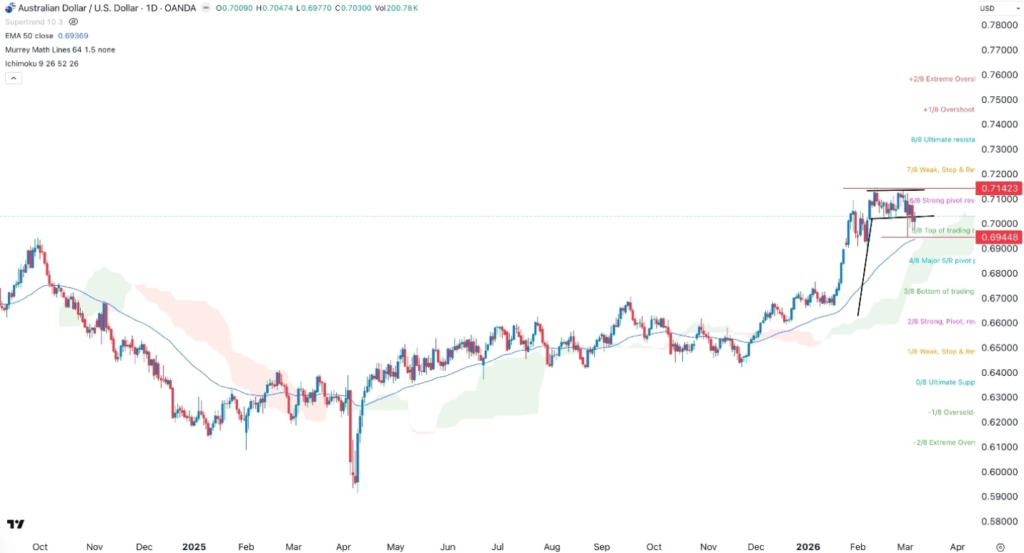
From a technical analysis perspective, the AUD/USD pair is showing encouraging signs of bullish continuation. On the daily timeframe chart, the pair has stabilized near the important resistance level of 0.7030, after rebounding from the monthly low of 0.6945.
Several technical indicators reinforce the positive outlook.
First, the pair has remained above the 50-day Exponential Moving Average (EMA), which is commonly viewed as a key indicator of medium-term trend direction. Staying above this level suggests that buyers continue to maintain control of the market.
Second, the pair is trading above the Ichimoku Cloud, another widely used technical indicator that helps identify trend direction, support levels, and momentum. When prices remain above the cloud, it generally signals a strong bullish bias.
Bullish Flag Pattern Signals Potential Breakout
Another important technical development is the formation of a bullish flag pattern on the daily chart. This pattern typically appears after a strong upward movement and consists of a sharp vertical rally followed by a downward-sloping consolidation channel.
In technical trading theory, the bullish flag is considered a continuation pattern, suggesting that the previous upward trend is likely to resume after the consolidation phase concludes.
If this pattern plays out as expected, the AUD/USD pair could continue its upward trajectory toward the upper boundary of the channel near 0.7142.
However, traders should also monitor downside risk carefully. A decisive move below the key support level of 0.6945 would invalidate the bullish structure and could signal a potential trend reversal.
Outlook for AUD/USD
Overall, the outlook for AUD/USD remains cautiously bullish, supported by technical momentum, rising commodity prices, and signs of softness in the US economy. At the same time, geopolitical developments and energy market volatility will likely remain dominant drivers of currency movements in the near term.
If global risk sentiment stabilizes and the US dollar weakens further, the pair could extend gains toward 0.7142 and potentially higher levels. However, traders should remain vigilant as macroeconomic data releases, central bank expectations, and geopolitical events continue to shape the broader forex market landscape.


