
Alibaba Group (BABA) made significant strides in 2025, not by staging a dramatic comeback, but by shifting its strategy to better align with long-term growth trends.
Brokers from SkylineSFO note that, after a period of regulatory pressure and investor skepticism, Alibaba’s shift toward cloud computing and artificial intelligence (AI) could position it for a much more promising future. While the company didn’t experience a sudden surge to its past dominance, it showed clear signs of stabilization and long-term strategy clarity that investors should pay attention to.
1. Cloud and AI: Alibaba’s New Growth Engine
In 2025, Alibaba’s cloud business accelerated, driven by rising AI demand. In the September 2025 quarter, Alibaba Cloud reported a 34% year-over-year revenue increase, becoming the company’s fastest-growing segment.
More importantly, AI-related cloud revenue continued to grow at triple-digit rates, signaling that cloud is shifting from a supporting asset to Alibaba’s primary long-term growth engine. Alibaba’s cloud now supports AI workloads such as model training, inference, and enterprise AI services, requiring more computing power than traditional cloud tasks, driving higher spending per customer and improving long-term revenue quality.
By positioning itself as a core infrastructure provider for China’s AI adoption, Alibaba has gained the trust of major enterprises across logistics, internet services, and industrial applications. The company’s integrated platform, which includes cloud services, Qwen (Tongyi Qianwen) language models, and AI development tools, now competes with Western giants like Amazon’s AWS and Microsoft Azure, but is tailored to China’s unique regulatory and enterprise landscape.
For investors, this shift solidifies Alibaba’s position as a technology and AI powerhouse, rather than just an e-commerce leader.
2. E-Commerce Stabilization: A New Foundation
Alibaba’s e-commerce business didn’t return to previous growth levels in 2025, but it stabilized, easing concerns about the company’s future. For the half-year period ending September 30, 2025, e-commerce customer management revenue grew 10% year-over-year, driven by improving user engagement and better retention.
This was a significant achievement, especially given the intense competition from Pinduoduo, JD.com, Douyin, and Meituan. Investors now view Alibaba’s e-commerce as a mature and resilient foundation that can support future investments in cloud and AI technologies. The company met the 2025 benchmark, held market share, maintained engagement, and avoided further erosion, without needing headline growth.
3. A Technology and AI Platform: Alibaba’s New Identity
In 2025, Alibaba transitioned from being solely an e-commerce giant to a more comprehensive technology and AI platform. The company started positioning itself not only as a leader in e-commerce but also as a cloud, AI, and enterprise technology provider.
Alibaba showcased AI-driven improvements in Taobao and Tmall, along with the broader integration of AI in areas such as logistics and enterprise software. This shift has established Alibaba as a crucial infrastructure provider, particularly through its cloud and AI divisions, enabling businesses to create AI-powered workflows.
While e-commerce still plays a role in Alibaba’s ecosystem, it is no longer the primary driver of its strategic direction. Instead, cloud and AI have become the focal points, transforming Alibaba into a more diversified platform with broader growth opportunities for the next decade. This identity shift is crucial because a commerce-only Alibaba faces growth limitations, whereas a technology platform anchored in AI and cloud offers far more optionality and potential for sustained growth.
4. What Does This Mean for Investors?
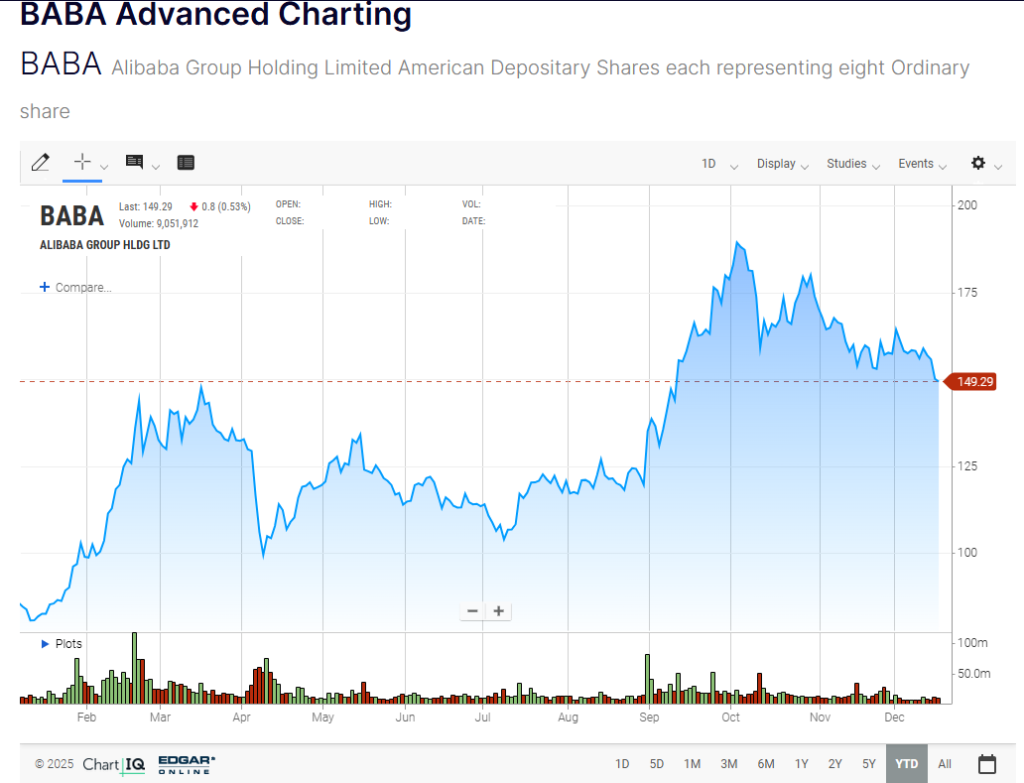
Alibaba still faces several challenges: competition is fierce, margins are under pressure, and investor sentiment toward Chinese tech stocks can fluctuate. However, 2025 showed something that investors haven’t seen in a while: coherence in the company’s strategy.
- Cloud and AI are now driving Alibaba’s growth, moving the company beyond its e-commerce roots.
- E-commerce has stabilized, providing a strong base for future investments.
- Alibaba has successfully clarified its identity as a technology platform, no longer relying solely on its commerce business.
For long-term investors, these changes hold more weight than short-term earnings volatility. Alibaba is no longer a company stuck in between its past achievements and future uncertainty. It is now positioning itself for its next chapter as a technology-focused company, with a clear emphasis on AI and cloud innovation.
Conclusion: A Reset Year, Not a Comeback
2025 wasn’t a comeback year for Alibaba, but it was a reset year that could mark the beginning of a more durable recovery. Brokers emphasize that Alibaba’s strategic pivot to cloud and AI creates significant opportunities for long-term growth.
While challenges remain, Alibaba’s ability to stabilize its core e-commerce business and pivot toward new technologies makes it a promising stock for those looking for exposure to China’s growing tech and AI sectors. 2025 may not have been dramatic, but it set the stage for Alibaba’s next phase, one that could offer substantial returns for patient investors.


