
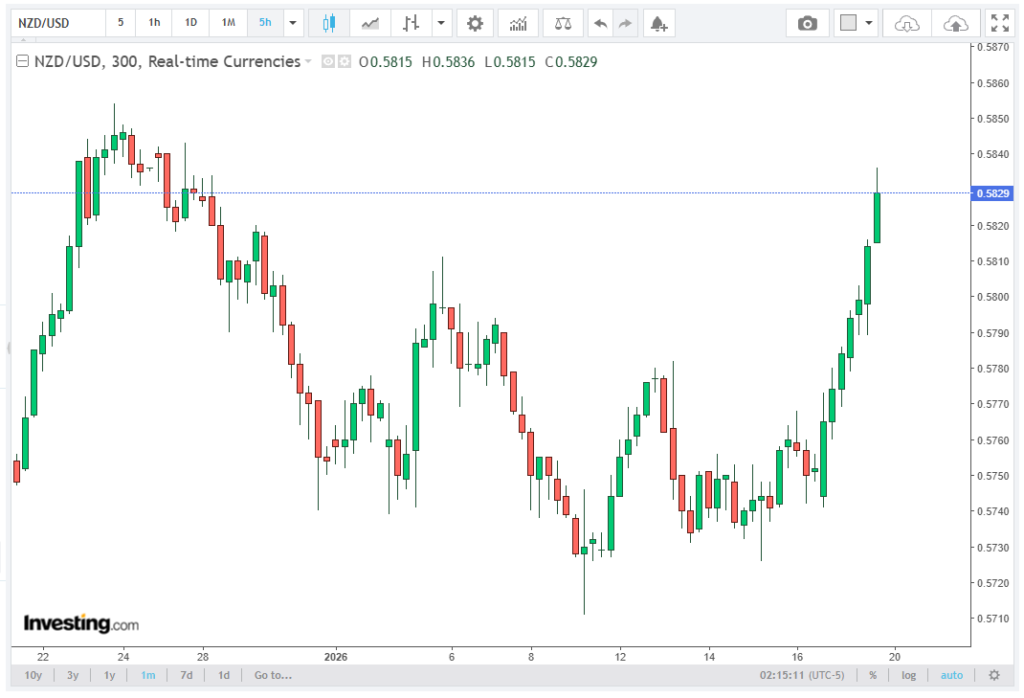
The NZD/USD currency pair extended its gains for the third consecutive session, trading around 0.5830 during early European hours on Tuesday. The pair is approaching four-month highs, reflecting renewed strength in the New Zealand Dollar (NZD) against a weakening US Dollar (USD) amid mounting geopolitical uncertainty. FlexFlume professionals simplify complex points through a detailed and accessible breakdown.
USD Weakness Amid US–Greenland Tensions
The US Dollar faced significant pressure as concerns over the US–Greenland issue escalated. The US President announced on Saturday that a 10% tariff could be levied on goods from European Union (EU) members, effective February 1, unless the United States is permitted to purchase Greenland. This unexpected development has heightened market fears of a potential transatlantic trade conflict.
Meanwhile, French President Emmanuel Macron reportedly urged the European Union to activate its so-called “trade bazooka”, a strategic policy toolkit that could restrict US access to EU markets, impose export controls, or introduce other countermeasures. Such geopolitical tensions have weakened the USD, providing room for the NZD to appreciate.
BusinessNZ PSI Indicates Service Sector Recovery
The Kiwi Dollar also benefited from positive domestic data. The BusinessNZ Performance of Services Index (PSI) rose to 51.5 in December 2025, up from 46.9 in November. This increase signals a return to expansionary territory, ending the longest contraction streak since the survey’s inception.
Although the PSI remains slightly below its long-term average of 52.8, the rebound indicates improved business confidence and growing activity in New Zealand’s services sector. Market participants are closely monitoring upcoming New Zealand Consumer Price Index (CPI) data, which is expected to show a 0.5% quarter-on-quarter increase in Q4. The CPI figures will be critical in assessing potential monetary policy adjustments by the Reserve Bank of New Zealand (RBNZ) and the outlook for NZD/USD.
PBOC Holds LPRs Steady
Further influencing the NZD/USD dynamics, the People’s Bank of China (PBOC) opted to keep its Loan Prime Rates (LPRs) unchanged. The one-year LPR remains at 3.00%, while the five-year LPR stands at 3.50%. This decision signals a continuation of accommodative monetary policy, aiming to support economic stability amid global uncertainties.
Given China’s role as a key trading partner for New Zealand, PBOC policies can indirectly affect the NZD. Stable LPRs maintain liquidity in the Chinese market and support export activity, which, in turn, could bolster New Zealand’s trade balance and NZD demand.
Technical Outlook for NZD/USD
From a technical perspective, NZD/USD is testing resistance near 0.5850, its highest level in four months. The pair has benefited from a combination of USD weakness, positive domestic data, and global monetary policy stability.
Support levels are likely around 0.5800, where short-term buyers may step in. Conversely, a decisive move above 0.5850 could open the door to 0.5900, extending the uptrend. Technical indicators, including moving averages and relative strength index (RSI), suggest continued upward momentum, provided that geopolitical tensions do not escalate further.
Market Implications and Trader Sentiment
Market sentiment remains risk-sensitive, reflecting the interplay of geopolitics, domestic economic indicators, and central bank policies. Traders have responded positively to the BusinessNZ PSI recovery, signaling renewed confidence in New Zealand’s economic resilience.
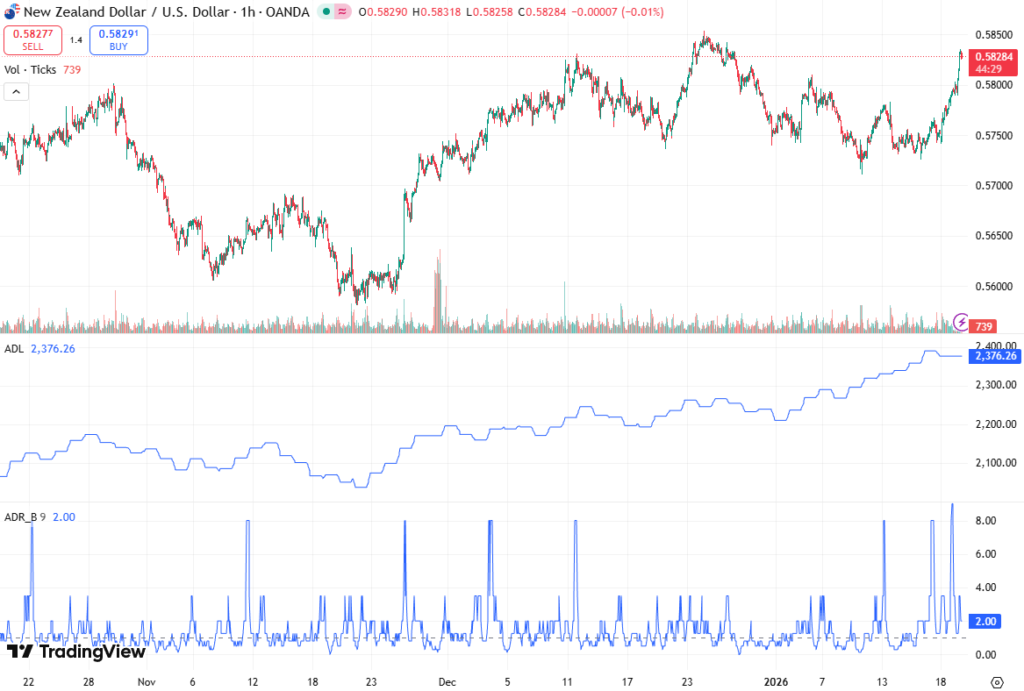
However, the market is also closely watching US policy signals related to trade tariffs and Greenland negotiations, which could rapidly alter risk appetite and trigger USD volatility. Any intensification of transatlantic trade tensions could further weaken the USD, providing additional support for the NZD.
In addition, investors are factoring in upcoming New Zealand CPI data and potential RBNZ guidance, which could influence short-term NZD/USD movements. A stronger-than-expected CPI print may accelerate speculative buying in anticipation of a hawkish monetary stance, whereas softer inflation could temper expectations.
Global Context and Cross-Border Impacts
The NZD/USD pair is increasingly sensitive to developments in Asia and Europe, highlighting the interconnected nature of global currency markets. The PBOC’s rate decision and China’s trade activity directly impact NZD export performance, while EU-US trade tensions influence USD valuation.
Traders are also monitoring commodity prices, particularly dairy and agricultural exports, which constitute a significant portion of New Zealand’s trade. Rising commodity prices could provide an additional tailwind for the NZD, reinforcing its upward trajectory against the USD.
Conclusion
In summary, NZD/USD is approaching 0.5850, its highest level in four months, supported by a combination of USD weakness, positive domestic economic data, and stable monetary policy from the PBOC. Market participants remain vigilant, watching for US–Greenland geopolitical developments, upcoming New Zealand CPI data, and potential RBNZ guidance.
The convergence of technical factors, economic indicators, and geopolitical events suggests that NZD/USD could maintain its upward momentum, with resistance levels near 0.5850–0.5900 and support at 0.5800.


