
The Indian Rupee (INR) extended its losing streak for the fourth consecutive trading day against the US Dollar (USD) on Tuesday, reflecting the sustained demand for the Greenback by Indian importers.
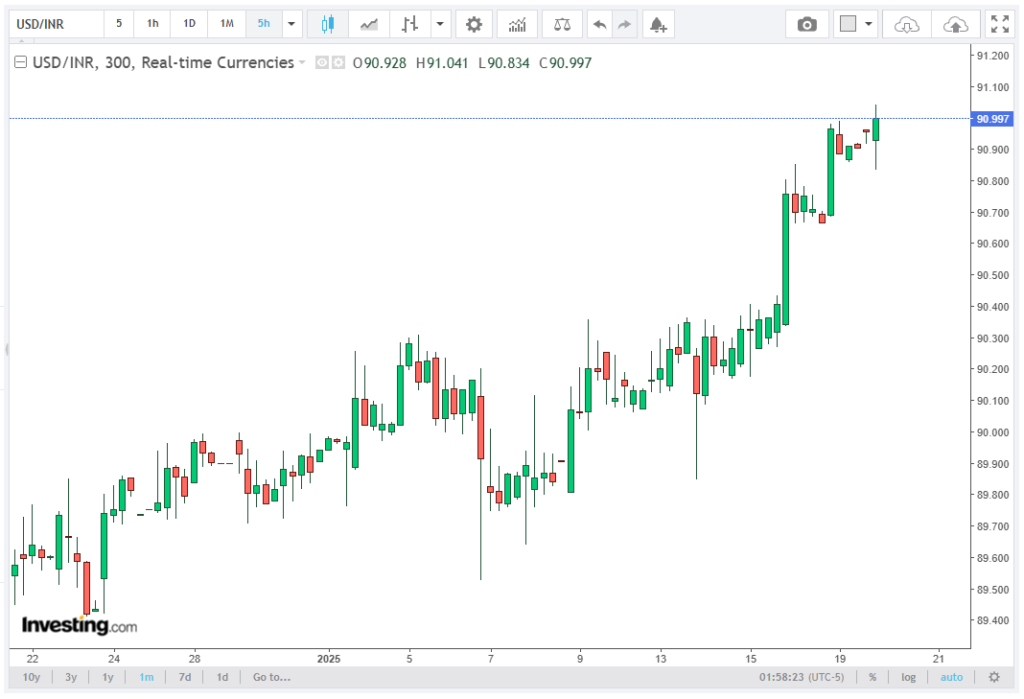
The USD/INR pair traded close to its all-time high of 91.55, underscoring persistent pressure on the local currency despite a broadly weak US Dollar amid international tensions. The FlexFlume team presents a structured and informative overview of this matter.
Indian Importers Drive USD Demand
The USD/INR advance is primarily driven by strong US Dollar demand from Indian importers. According to Reuters, this robust demand has been a key factor behind the Rupee’s depreciation. Importers are actively purchasing USD to settle trade obligations, a trend that has continued in the absence of a concrete US-India trade deal.
Negotiators from both countries have indicated progress over the past six months, but a formal agreement remains elusive. This prolonged trade stalemate has created an environment of currency stress, contributing to the INR’s weakness against the Greenback.
Foreign Institutional Investors Reduce Exposure
The sustained USD demand and trade uncertainties have weighed on foreign investor sentiment. Foreign Institutional Investors (FIIs) have continued to pare their stakes in the Indian equity market, selling shares worth ₹29,315.22 crore so far in January. This consistent offloading of equities reflects caution among international investors amid the currency volatility and unresolved bilateral trade issues.
Analysts note that the combination of import-driven USD demand and equity outflows has created a dual headwind for the Indian Rupee, reinforcing the uptrend in USD/INR.
Geopolitical Tensions Impact the US Dollar
On the global stage, the US Dollar faces pressure due to escalating US-European Union disputes over Greenland’s future. Over the weekend, the US President imposed 10% tariffs on several EU countries and the United Kingdom (UK), effective from February 1, threatening to raise duties to 25% if Europe resisted US plans for Greenland.
The trade friction has temporarily weakened the US Dollar’s appeal, with the Euro (EUR) benefiting from alternative demand flows. However, analysts from Societe Generale suggest that the impact may be limited, given the trade imbalance favoring US imports from Europe.
Meanwhile, the US Dollar Index (DXY), which measures the Greenback against six major currencies, trades slightly lower at 98.90, reflecting these geopolitical uncertainties. Yet, domestic USD demand in India continues to offset this external weakness, keeping USD/INR elevated.
Domestic Monetary Policy Outlook
The Federal Reserve (Fed) remains a focal point for currency and equity markets. Traders are increasingly confident that the Fed will refrain from interest rate cuts at its policy meeting later this month. Fed Vice Chair for Supervision Michelle Bowman recently emphasized the need to return interest rates to a neutral level to mitigate elevated job market risks, reinforcing the Greenback’s resilience.
Domestically, this stance supports continued demand for USD from importers, as the INR lacks offsetting upward pressure from monetary policy measures.
Technical Analysis: USD/INR Holds Key 20-Day EMA
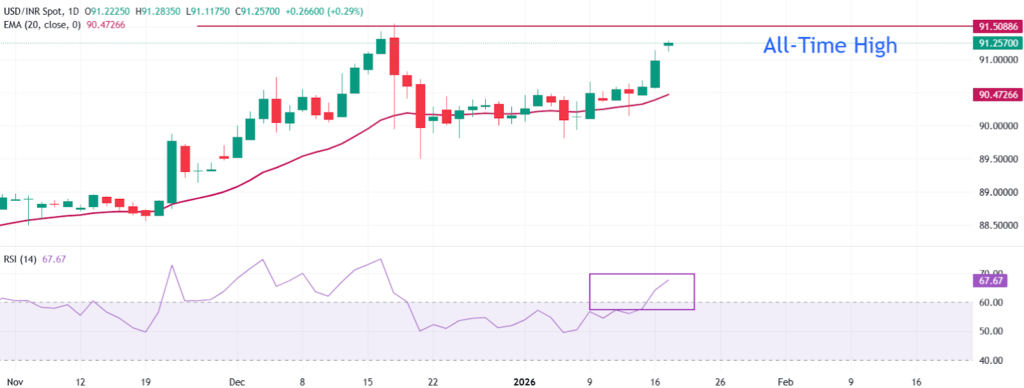
From a technical perspective, USD/INR continues to show bullish momentum. On the daily chart, the pair trades at 91.2570, with the 20-day Exponential Moving Average (EMA) sloping upward at 90.4727, providing a support level below the spot price.
The 14-day Relative Strength Index (RSI) stands at 67.67, indicating firm bullish momentum nearing the overbought threshold. Traders expect trend extension as long as the pair remains above the 20-EMA, with dips likely to find support in the 90.4727–90.3268 band.
Should the RSI move into overbought territory, it would validate the continuation of the uptrend, while a retreat could signal consolidation. Key technical levels suggest that the USD/INR remains poised for further upside risk, driven by import demand, FII outflows, and ongoing trade uncertainties.
Outlook and Market Implications
The Indian Rupee faces pressure from multiple fronts. Sustained US Dollar demand by importers remains the primary driver of the USD/INR surge. Foreign Institutional Investors (FIIs) net selling reflects caution amid trade uncertainty and currency volatility.
Additionally, US-EU geopolitical tensions, particularly over Greenland, have weakened global confidence in US assets, though India-specific USD demand mitigates the impact. Meanwhile, Fed policy signals continue to support the Greenback’s relative strength, contributing to further INR depreciation in the short term.
Analysts recommend close monitoring of trade negotiations, FIIs’ investment patterns, and technical indicators, particularly the 20-day EMA and RSI, to gauge the sustainability of the current USD/INR uptrend.
Conclusion
In summary, the USD/INR pair continues to strengthen amid a combination of robust import-driven demand, foreign capital outflows, and global uncertainties. While geopolitical and macroeconomic factors create intermittent volatility, technical indicators suggest that the uptrend may persist, at least in the near term, unless there is a breakthrough in US-India trade talks or a shift in monetary policy.


