
The EUR/USD currency pair extended its bearish momentum on Monday morning, sliding to its lowest level since December 2nd as geopolitical risks resurfaced and traders positioned ahead of key macroeconomic events. The pair dropped toward 1.1600, well below its year-to-date high of 1.1805, reflecting a renewed preference for the US dollar amid uncertainty.
With European inflation data, central bank commentary, and US inflation metrics approaching, volatility in the world’s most traded forex pair is expected to remain elevated. In this article, FlexFlume brokers break down the key aspects of the topic with clarity.
Geopolitical Risks Return
The EUR/USD pair retreated sharply after geopolitical risks returned to the spotlight over the weekend. Reports that the US President threatened several European countries with new tariffs linked to the Greenland issue unsettled markets. According to the statements, the US could impose an additional 10% tariff initially, potentially increasing it to 25% later this year until negotiations succeed.
Such rhetoric revived concerns over a renewed trade conflict, prompting investors to seek the relative safety of the US dollar. Historically, tariff threats and trade uncertainty have weighed on the euro, particularly when they risk disrupting export-driven European economies. Even if these measures are later challenged or diluted, the headline risk alone has proven sufficient to pressure the common currency.
Focus Shifts to European Inflation Data
Attention now turns to the European inflation report, scheduled for release on Monday. Economists expect headline inflation to have eased from 2.1% in November to 2.0% in December, while core CPI, which excludes volatile food and energy prices, is forecast to decline to 2.3%.
If confirmed, these figures would place inflation right at the European Central Bank’s (ECB) target, reinforcing the narrative that price pressures are stabilizing across the euro area. As a result, the ECB is unlikely to rush into interest rate cuts early this year. In fact, some analysts argue that persistent wage growth and resilient services inflation could even open the door to a rate hike in the fourth quarter.
This outlook contrasts with expectations for the US Federal Reserve, where markets are increasingly confident that monetary easing will begin later this year, though timing remains data-dependent.
ECB Communication and Legal Risks Ahead
Another major catalyst will be a speech by ECB President Christine Lagarde, scheduled for Wednesday. Investors will closely analyze her remarks for clues on inflation dynamics, economic growth, and policy direction ahead of upcoming ECB meetings. Any hawkish tilt could offer temporary support to the euro, while a dovish tone would likely reinforce the current downtrend.
The EUR/USD pair will also react to an upcoming US Supreme Court decision regarding the legality of the US’s tariffs. While the court is widely expected to rule against the existing measures, analysts note that the US President may still have alternative legal avenues to impose similar levies. This ongoing uncertainty keeps trade policy risk firmly on the radar.
US PCE Inflation: A Crucial Dollar Driver
On Thursday, the United States will release the latest Personal Consumption Expenditure (PCE) inflation data, the Federal Reserve’s preferred inflation gauge. Consensus estimates suggest that headline PCE inflation eased from 2.8% to 2.7% in November.
A softer reading would strengthen expectations that the Fed is making progress toward its inflation goal, potentially capping further US dollar upside. However, if inflation proves stickier than expected, it could reinforce the rate differential in favor of the dollar, adding more downside pressure on EUR/USD.
EUR/USD Technical Analysis
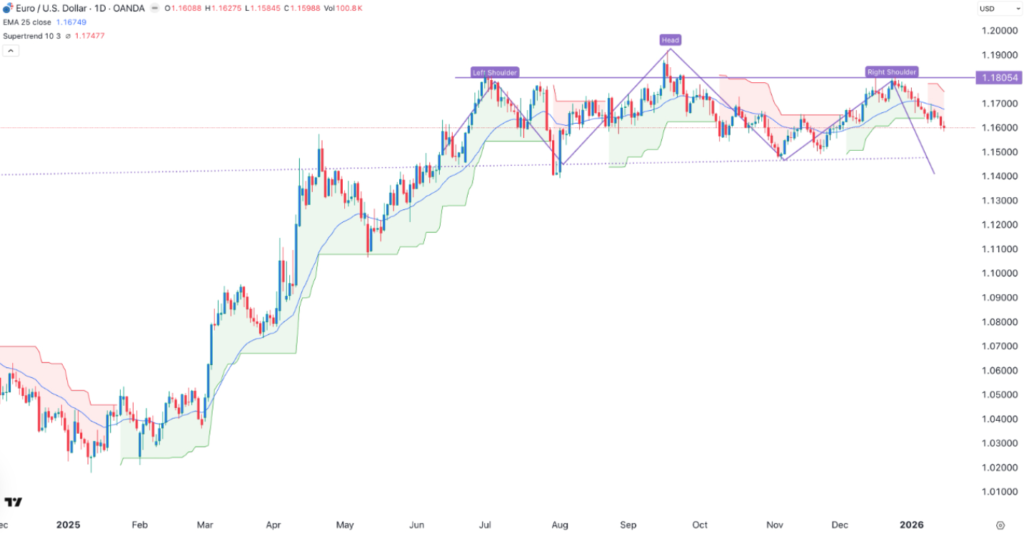
From a technical perspective, the EUR/USD pair has been in a strong downward trend over the past two weeks. It is now trading below the 50-day Exponential Moving Average (EMA), a key signal that bearish momentum remains intact.
Most notably, the pair has formed a head-and-shoulders pattern, one of the most reliable bearish reversal formations in technical analysis. This pattern suggests that buyers are losing control and that sellers are increasingly dominant. Adding to the bearish case, the pair has also moved below the Supertrend indicator, further confirming that bears remain in control.
Outlook and Price Targets
Given the combination of negative technical signals, geopolitical uncertainty, and event risk, the EUR/USD pair is likely to continue falling in the near term. Sellers are now targeting the next key psychological support level at 1.1500. A decisive break below this level could open the door to deeper losses, while any rebound toward former support near 1.1700 may be viewed as selling opportunities.
In summary, unless upcoming data or central bank communication delivers a clear bullish surprise for the euro, the path of least resistance for EUR/USD remains to the downside.


