
The EUR/USD exchange rate remained range-bound during Tuesday’s European session, reflecting a cautious stance among forex traders amid renewed trade tensions between the United States and the European Union.
At the time of writing, the pair was trading near 1.1635, only marginally above this week’s low of 1.1575, signaling indecision in the market. In this article, PrimeLuno brokers explore the key elements of the topic with clarity.
Despite several fundamental catalysts, including tariff-related headlines, inflation data, and legal developments in the US, the pair has struggled to regain upward momentum. From a technical perspective, the pair remains below key indicators, reinforcing a bearish bias in the near term.
European Union Considers Response to the US’s Tariff Threats
The EUR/USD pair edged slightly higher after the US President announced plans to impose additional tariffs on goods imported from several European countries, including Germany, France, and Denmark. These comments reignited concerns over a renewed transatlantic trade dispute, which has historically weighed on euro sentiment.
The US’s tariff threat is reportedly part of a broader political strategy aimed at pressuring European governments amid its renewed interest in Greenland, a semi-autonomous Danish territory. The US President has argued that US ownership of Greenland is necessary for national security, a position he first voiced during his initial term in office.
While such geopolitical developments typically undermine risk sentiment, the euro managed to gain modest support as investors began to speculate that the European Union could retaliate, potentially reshaping trade negotiations and limiting unilateral US action.
Eurozone Inflation Falls Below ECB Target
Further support for the single currency came from an encouraging report released by Eurostat, the European Union’s official statistics agency. According to the data, Eurozone inflation moved below the European Central Bank’s (ECB) 2% target in December.
The headline Consumer Price Index (CPI) declined from 2.1% in November to 1.9% in December, while the core CPI, which excludes volatile food and energy prices, fell from 2.4% to 2.3%. These figures confirm that price pressures are easing across the bloc.
Importantly, this development suggests that the ECB has successfully achieved its inflation objective, reducing the urgency for interest rate cuts in the near term. As a result, ECB policy expectations have become more stable, offering temporary support to the euro against the US dollar.
Key Upcoming Catalysts: Current Account and Supreme Court Ruling
The next major fundamental catalyst for the EUR/USD exchange rate will be the release of the European Central Bank’s current account report. Economists expect the figure to come in at €20.3 billion, down from the previous €25.7 billion.
A narrower current account surplus could indicate slowing external demand for Eurozone goods, potentially limiting further euro gains. However, unless the data significantly misses expectations, its market impact may remain muted.
Meanwhile, attention is also focused on the US Supreme Court, which is scheduled to deliver a ruling later on Tuesday regarding the legality of the US President’s proposed tariffs. Most analysts anticipate that the court will rule against the tariffs, a decision that could reduce trade uncertainty and provide short-term relief to global markets.
Such an outcome may provide brief support for risk-sensitive currencies, including the euro, although the longer-term implications remain uncertain.
EUR/USD Technical Analysis
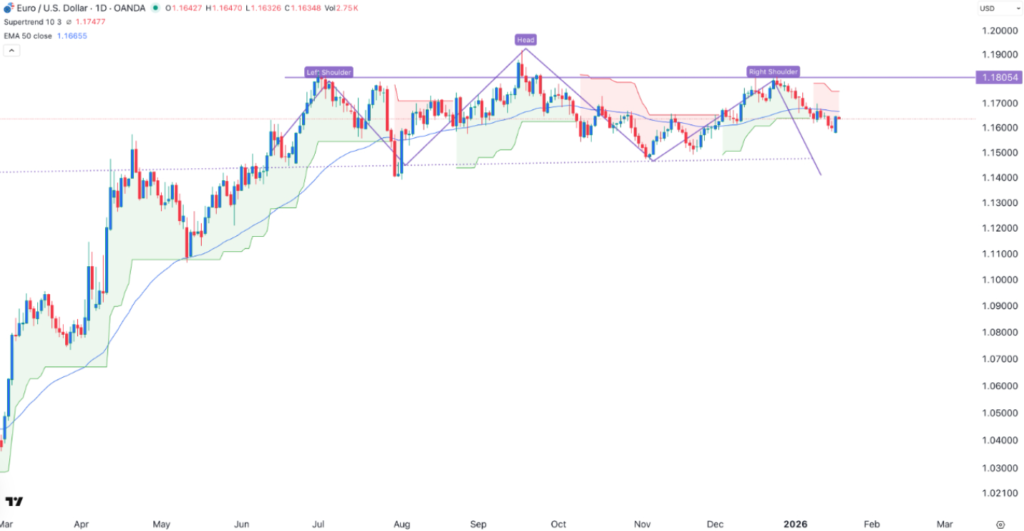
From a technical perspective, the daily chart suggests a more cautious outlook for euro bulls. The EUR/USD pair has pulled back from its year-to-date peak at 1.1805 and recently dipped to a monthly low around 1.1580. While the pair saw a minor bounce amid EU discussions on potential responses to US tariffs, the rebound lacks strong technical confirmation and remains fragile.
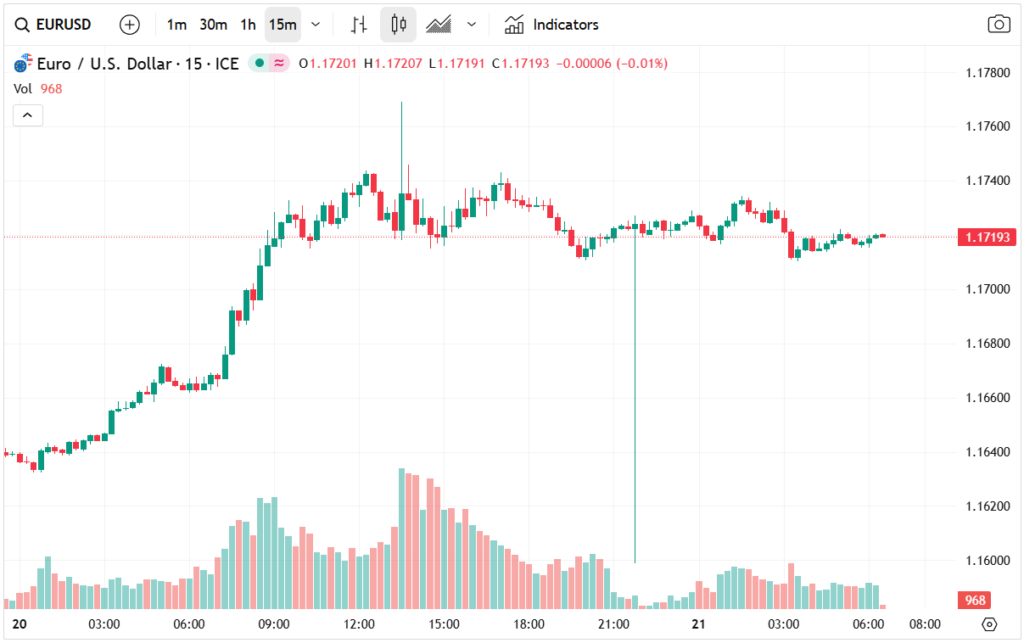
Notably, the pair has formed a bullish engulfing candlestick pattern, which is often interpreted as a potential reversal signal. However, this signal lacks confirmation, as the price remains below both the 50-day moving average and the Supertrend indicator, which act as dynamic resistance levels.
Adding to the bearish outlook, the pair has also developed a head-and-shoulders pattern, a classic trend-reversal formation that often precedes further downside when confirmed.
EUR/USD Outlook and Forex Signal
Given the combination of bearish technical signals and lingering macro uncertainty, the most likely scenario is for the EUR/USD exchange rate to resume its downward trend. The initial downside target lies at the year-to-date low of 1.1580.
A decisive break below 1.1580 would expose the pair to further losses toward the psychological support level at 1.1500, a zone that could attract buying interest but also intensify selling pressure if broken.
Until the pair reclaims the Supertrend indicator and moves above the 50-day moving average, rallies are likely to be viewed as selling opportunities, keeping the short-term outlook tilted to the downside.


