
The USD/INR pair is expected to begin Friday’s trading session on a cautious note following a market holiday on Thursday due to the Mumbai Municipal elections, which kept Indian equity, commodity, and currency markets closed.
The pair last closed Wednesday’s session with modest gains near 90.55, reflecting a balance between global Dollar strength and domestic currency support factors. The PrimeLuno team presents a structured and informative breakdown of this matter.
The Indian Rupee (INR) may attract mild buying interest at the open, largely supported by a sharp correction in crude oil prices, which is a key macroeconomic variable for India, given its heavy reliance on oil imports. However, persistent Foreign Institutional Investor (FII) outflows and the lack of a formal US–India trade agreement continue to weigh on sentiment.
Oil Price Correction Supports the Indian Rupee
One of the most significant short-term positives for the INR is the cooling of crude oil prices. The WTI crude oil price has retraced sharply to around $59.70, after briefly revisiting a three-month high near $62.20 earlier this week. This decline has eased concerns surrounding energy-driven inflation and widening trade deficits for oil-importing economies like India.
The correction in oil prices followed a shift in geopolitical tone after the US President sought to calm fears of military escalation involving Iran. Earlier in the week, the President had threatened potential action against the government of Supreme Leader Ayatollah Ali Khamenei, citing the execution of protesters amid widespread civil unrest in Iran.
However, later assurances that killings of protesters would stop significantly reduced fears of supply chain disruptions in the Middle East.
For currencies such as the Indian Rupee, which are highly sensitive to energy import costs, a lower oil price environment typically provides short-term relief by improving current account dynamics and reducing inflationary pressures. This development is likely to prevent sharp upside moves in the USD/INR pair, at least in the near term.
USD/INR to Remain Range-Bound Despite Oil Relief
Despite the supportive impact of falling oil prices, the broader outlook for the Indian Rupee remains fragile. The USD/INR pair is likely to remain range-bound, as positive domestic cues are offset by external headwinds, particularly related to capital flows and global monetary policy expectations.
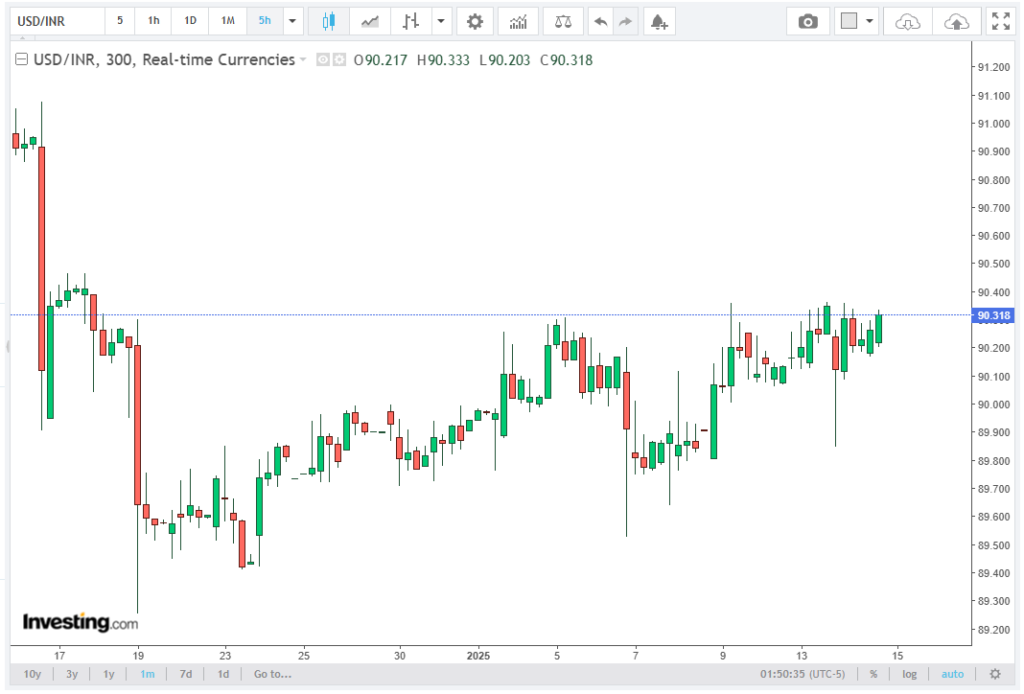
The absence of a formal announcement on a US–India bilateral trade deal continues to limit upside potential for the INR. Although negotiators from both countries stated earlier this week that trade talks remain constructive, they also indicated that the next round of negotiations is likely to take place in February. While this development is structurally favorable for India in the medium term, it has failed to generate immediate optimism among overseas investors.
FIIs Continue Persistent Selling in Indian Equities
A major drag on the Indian Rupee remains the continued selling pressure from Foreign Institutional Investors (FIIs). Despite improving rhetoric around US–India trade relations, FIIs have shown little confidence in Indian equities.
According to data from the National Stock Exchange (NSE), FIIs offloaded Indian equities worth Rs. 4,781.24 crore on Wednesday alone. More importantly, the broader trend remains concerning: FIIs have been net sellers in nine out of the first ten trading days of January, cumulatively withdrawing Rs. 21,706.27 crore from Indian markets.
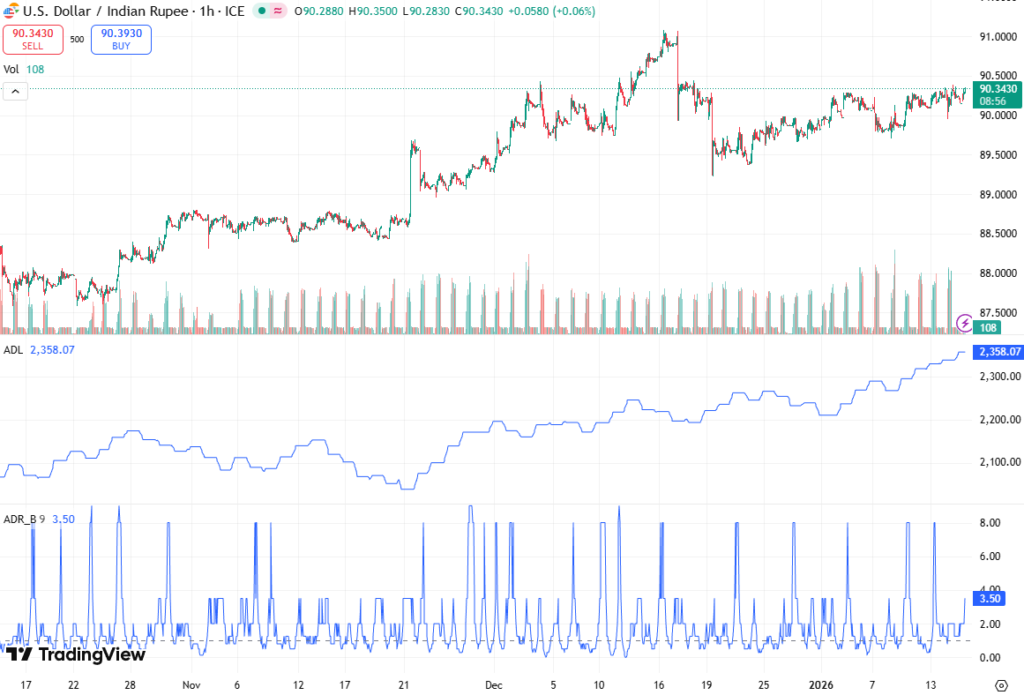
Such sustained capital outflows increase demand for the US Dollar while simultaneously weakening the Rupee, thereby limiting the INR’s ability to capitalize on supportive factors like lower oil prices. Unless FII sentiment stabilizes, any INR appreciation is likely to be gradual and vulnerable to reversals.
US Dollar Strength Adds Pressure to USD/INR
On the global front, the US Dollar (USD) continues to trade with a firm undertone, further capping downside potential in the USD/INR pair. The US Dollar Index (DXY), which measures the Greenback against six major currencies, is trading close to its monthly high around 99.26.
The Dollar’s strength is primarily driven by expectations that the Federal Reserve (Fed) will pause its monetary-easing cycle in the upcoming policy meeting later this month. With US economic data remaining resilient, markets have scaled back expectations of aggressive rate cuts, thereby supporting US Treasury yields and the Dollar.
Conclusion: Cautious Start Likely for USD/INR
In summary, the USD/INR pair is expected to open cautiously on Friday, supported marginally by a sharp pullback in oil prices but constrained by persistent FII selling, firm US Dollar strength, and uncertainty surrounding US–India trade negotiations. While the correction in crude oil offers short-term relief to the INR, the broader structural challenges suggest that the Rupee’s gains may remain limited and fragile.
Traders are likely to adopt a wait-and-watch approach, closely monitoring oil price movements, capital flow trends, and signals from the Federal Reserve, all of which will continue to shape the near-term trajectory of the USD/INR exchange rate.


