
Reaching a $5 trillion market capitalization once sounded unrealistic, even for the world’s largest corporations. Yet as artificial intelligence reshapes the global economy, that milestone is now within reach.
Brokers from SkylineSFO note that two technology giants, Nvidia and Alphabet, are uniquely positioned to cross this historic threshold as early as 2026, driven by accelerating AI investment, strong competitive moats, and attractive valuations relative to their growth potential.
NVIDIA: The Backbone of the AI Infrastructure Boom
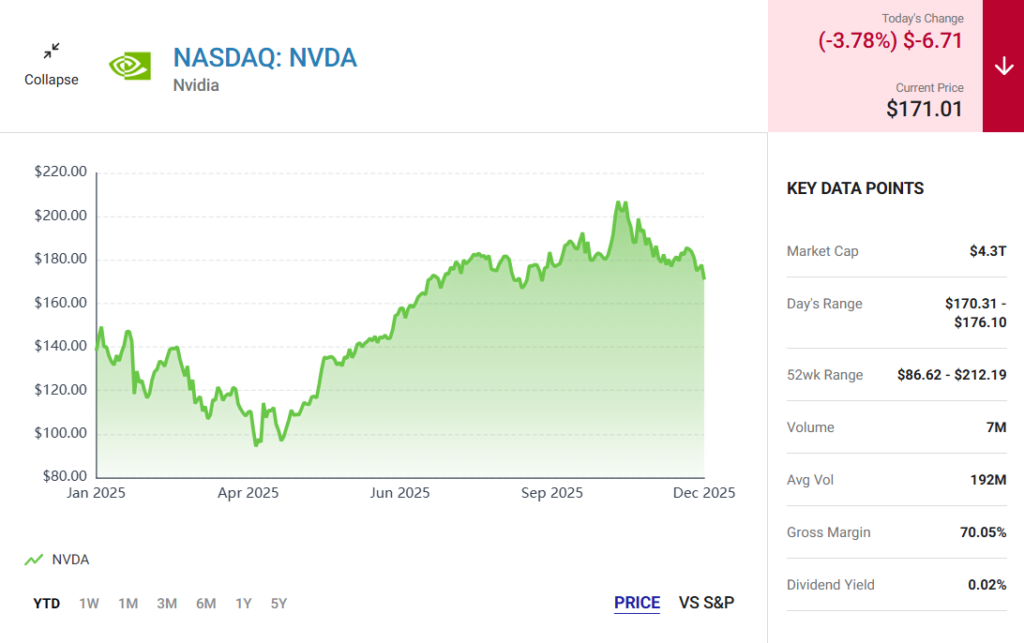
With a market cap approaching $4.3 trillion, Nvidia is already the most valuable company in the world. From current levels, the stock would need to rise by only around 16% to reach the $5 trillion mark, a move that appears achievable given current industry dynamics.
NVIDIA’s growth is being fueled by surging AI infrastructure spending, as cloud providers, enterprises, governments, and research institutions race to expand AI capabilities. Demand continues to outpace supply, even with massive capital expenditure budgets, underscoring the urgency and durability of this investment cycle.
At the core of this trend are Nvidia’s GPUs, which remain the dominant hardware for AI training and inference. Beyond chips, Nvidia’s edge lies in its CUDA software platform, now the industry standard for AI development. This deep software integration creates high switching costs, firmly anchoring customers within Nvidia’s ecosystem and reinforcing its long-term competitive advantage.
NVIDIA further strengthens its moat through NVLink, a proprietary interconnect that allows multiple GPUs to function as a single, powerful computing unit. This discourages customers from mixing hardware vendors and reinforces Nvidia’s leadership in large-scale AI workloads.
Importantly, valuation does not appear stretched relative to growth. NVIDIA trades at less than 24 times forward 2026 earnings and carries a PEG ratio near 0.6, a level typically associated with undervalued growth stocks. With demand visibility remaining strong and AI adoption still in early stages, Nvidia looks well-positioned to extend its rally into 2026.
Alphabet: From AI Doubts to AI Leadership
While Alphabet has more ground to cover, its path to $5 trillion is increasingly plausible. With a current market cap of roughly $3.7 trillion, Alphabet would need to gain about 35% to reach the milestone. Given that the stock is already up more than 60% in 2025, that level of appreciation is far from unprecedented.
Alphabet enters 2026 as the most profitable company in the world, supported by a diversified business model and improving investor confidence in its AI strategy. The company trades at around 27 times forward earnings, with a PEG ratio below 1, indicating a valuation that remains reasonable for a business of its scale and durability.
A key driver of Alphabet’s upside is how effectively its businesses reinforce each other. Google Cloud, once seen as a laggard, has become a critical pillar of Alphabet’s AI ambitions. What sets Alphabet apart is its structural cost advantage.
The company designs its own Tensor Processing Units (TPUs) and develops its own large language models through Gemini. This allows Alphabet to train models and run inference more cheaply than competitors reliant on third-party chips.

Lower costs improve Google Cloud’s margins and make its services more attractive to enterprise customers, while Gemini is increasingly embedded across Alphabet’s ecosystem, from search to productivity tools. This creates a virtuous cycle in which performance improvements feed adoption, which in turn strengthens scale advantages.
Beyond core AI operations, Alphabet also has meaningful optionality. Its Waymo robotaxi business continues to expand, and its sizable investment in SpaceX adds exposure to the fast-growing space economy. These assets are not fully reflected in Alphabet’s valuation but could provide additional upside as they mature.
What This Means for Investors
Both Nvidia and Alphabet represent rare combinations of scale, profitability, and growth at a time when AI is reshaping entire industries. NVIDIA stands to benefit directly from the infrastructure buildout powering AI adoption, while Alphabet leverages AI across multiple revenue streams, from cloud computing to search and emerging technologies.
For investors, the idea of two companies reaching $5 trillion market caps in 2026 underscores how transformational AI has become. This is not a speculative narrative driven by hype alone; it is supported by real spending, improving economics, and widening competitive advantages.
Final Thoughts
While no prediction is guaranteed, the case for Nvidia and Alphabet joining the $5 trillion club is grounded in strong fundamentals, favorable valuations, and long-term industry trends. Financial experts highlight that investors looking ahead to 2026 should focus less on whether these companies can grow and more on how sustainably they can extend their leadership. If AI spending continues at its current pace, Nvidia and Alphabet may not just reach $5 trillion but redefine what scale looks like in the modern market.


