
Costco Wholesale remains one of the most recognizable and resilient names in U.S. retail, supported by more than 600 warehouses nationwide and a highly loyal customer base that relies on the company for essentials ranging from groceries to fuel. Its membership-driven business model continues to generate consistent cash flow and shareholder value, even during challenging market conditions.
Although the stock has historically traded at a premium, recent market pullbacks have created a more attractive entry point for long-term investors. Analysts at SkylineSFO highlight Costco’s scale, pricing power, and recurring membership income as key strengths that set it apart from traditional retailers. These advantages help explain why Costco stock continues to stand out as a compelling long-term investment opportunity.
1. A Powerful Membership Engine Driving Profits
At the core of Costco’s long-term success is its membership-based business model, which provides a powerful and predictable source of profitability. While the company intentionally keeps product margins low to deliver value to customers, high-margin membership fees drive earnings. Importantly, membership renewal rates in the U.S. and Canada consistently exceed 90%, giving investors strong visibility into future cash flows and earnings stability.
Costco currently offers two membership tiers: Gold Star at $65 and Executive at $130. Recent trends show a steady shift toward the higher-priced Executive membership, which carries greater margins and strengthens recurring revenue. In the most recent quarter, Executive memberships increased by more than 9% year over year, signaling rising customer engagement and willingness to pay for added benefits.
This combination of loyal customers, predictable income, and growing premium memberships enhances Costco’s net income potential and reinforces the durability of its business model, even during uncertain economic periods.
2. Resilience Across Economic Cycles
Costco’s ability to thrive across economic cycles is rooted in its focus on essential goods offered at consistently low prices. Whether the economy is strong or under pressure, consumers rely on Costco for everyday necessities, making the business unusually resilient. During periods of inflation or economic slowdown, shoppers often turn to Costco even more frequently as they look to stretch household budgets without sacrificing quality.
The annual membership fee plays a crucial role in reinforcing this behavior. Once customers pay to join, they are incentivized to concentrate a larger share of their spending at Costco, boosting store traffic and deepening customer loyalty. This creates a durable spending loop that supports revenue even when broader retail trends weaken.
Historically, this model has allowed Costco to maintain steady revenue growth, while also limiting downside risk during market downturns. For investors, this resilience makes Costco a compelling long-term holding, particularly in uncertain or volatile economic environments.
3. Valuation Pullback Creates Opportunity
Costco has long carried a reputation as a premium retail stock, frequently trading at higher valuation multiples than competitors such as Walmart or Target. That premium has historically been justified by Costco’s unique warehouse model, high-margin membership income, and remarkably consistent earnings growth. However, recent market conditions have created a rare shift in the stock’s valuation profile.
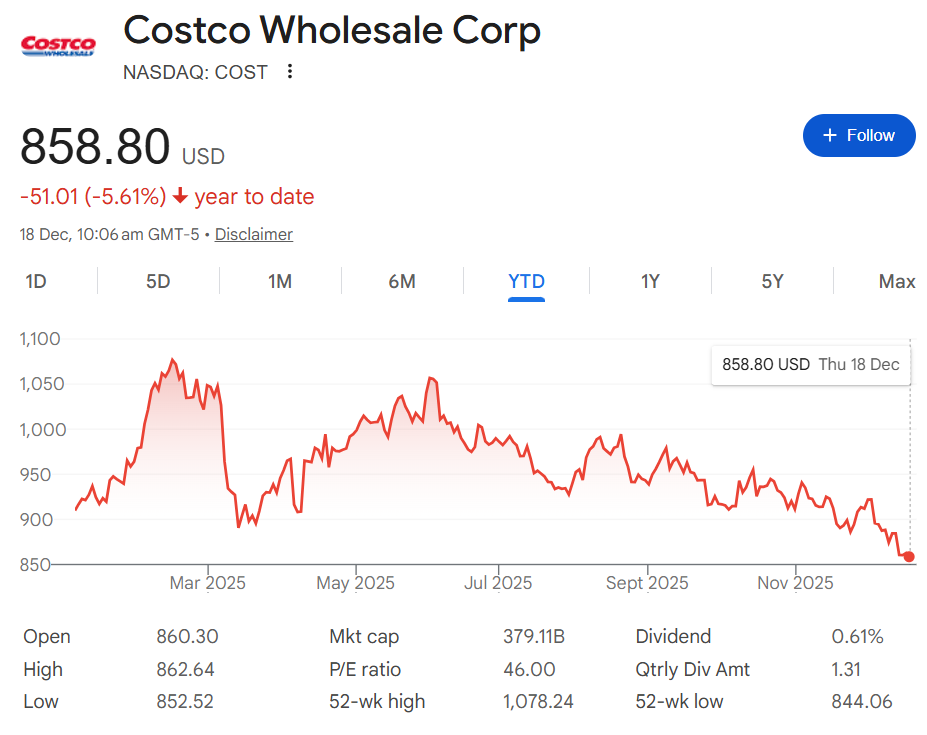
In 2025, Costco shares declined by approximately 6%, easing some of the valuation pressure that had built up during prior rallies. As a result, the company’s forward price-to-earnings ratio has fallen to around 42x, down significantly from nearly 58x earlier in the year. While still elevated relative to traditional retailers, this reset represents a meaningful normalization for a business that typically commands a scarcity premium in the market.
Importantly, this valuation adjustment has occurred without any deterioration in Costco’s core fundamentals. The company continues to benefit from exceptionally high membership renewal rates, strong customer loyalty, and a business model designed to perform well across economic cycles.
For long-term investors, the current pullback may offer an attractive entry point into a high-quality retailer with proven resilience. Buying Costco during periods of valuation compression has historically rewarded patient investors, and this dip could once again present a compelling opportunity to own a best-in-class retail business at a more reasonable price.
Bottom Line
Costco’s deeply loyal membership base, recession-resistant business model, and a recent valuation reset together create a compelling long-term investment thesis. The company’s high-margin membership fees generate reliable, recurring cash flow, while its emphasis on essential goods helps maintain consistent performance across economic cycles.
With shares now trading below previous valuation peaks, patient investors may see a more attractive entry point than earlier in the year. For those seeking stability, steady growth, and a proven retail leader, Costco remains a stock worth monitoring closely as market conditions continue to evolve.


